


The Pomodoro Technique
- Address the Stress
- Nov 29, 2022
- 3 min read

Updated: Dec 18, 2022
The Pomodoro technique helps you complete tasks efficiently and manage both time and energy effectively while being productive.

The Oxford Dictionary defines efficiency as"The ratio of the useful work performed by a machine or in a process to the total energy expended."
While it is mathematically impossible to be functioning at "100% efficiency", especially at all times, we can use methods and strategies like the Pomodoro technique to help reach as close as possible to this holy grail of productivity.
The Pomodoro technique does not micromanage the exact way you study — instead, it aims to use a time-based scheduling process that helps you maintain both your quality and quantity of task-efficiency over extended periods of time.
What is the Pomodoro Technique anyways?
The Pomodoro technique was developed by Francesco Cirillo in the late 1980s. It involves using a timer to help maintain focus over a long period of time.
The Pomodoro technique has been popularized since and has been recognised everywhere as one of the most efficient studying strategies. The basis of the entire technique is taking breaks to refresh your mind using efficient breaks.
Scenario
Let's say we have a friend named James. James has a GPA of 1.0. He decides that he needs to buck up on studying, so he decides he's going to study for 8 hours a day.
What GPA did he get next term? 2.0? 3.0?
Wrong. He got a 0.0 GPA.
What went wrong? Let's look at a graph of James' average productivity over the long nights he spent studying.

As can be seen by the graph, he started off fine. He maintained over 80% productivity for the first hour of work, but things quickly take a turn for the worse as they start to drop off after there. His productivity reduces to less than 50% after just another hour, less than 20% after 3 hours and by the fifth hour he's doing practically nothing. On top of this, he stays up late to do this, so he's sabotaging himself by sitting at his desk doing nothing instead of sleeping because he's too tired to work but he really wants to study and get good grades.
So what should he be doing in an ideal scenario?
He should be taking breaks for maximum productivity. We do not need a full 30-minute break to restore productivity; five minutes is good enough to get your productivity back. If we combine this with the average attention span of five minutes, we get a very efficient way of maintaining high energy levels for a long period of time.
Here is James' efficiency after applying this 25-5 work-break routine:
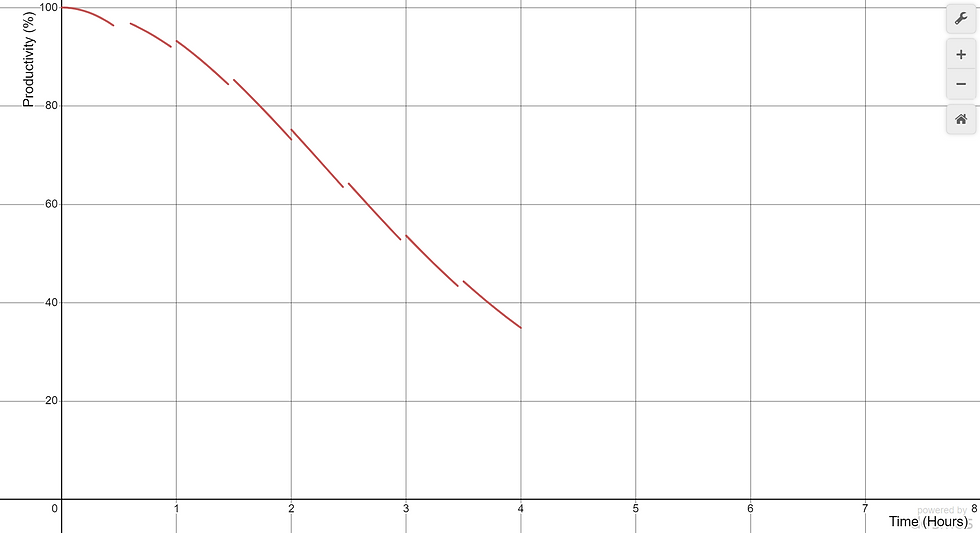
While this is really good at maintaining productivity for 2 hours or 4 cycles (nearly 75% productivity at 2 hours as compared to a previous less than 50%), it falls off sharply after that point. To counteract this, the Pomodoro method suggests you take a longer break of 15-30 minutes depending on your needs to restore your productivity.
Okay, cool. But how do I motivate myself to study in the first place?
Study motivation can be hard. The Pomodoro technique (or alternatively known as the 20-5 minute rule) is best used with incentives or rewards. In the five minute break, give yourself a small reward like calling a friend, listening to music or playing with your pet. In the longer breaks, give yourself a slightly bigger reward like a walk outside or watching your favourite show. After the whole day is done and you're finished with studying for the day give yourself a big reward like a bowl of ice cream.
You'll find that eventually, your brain will start to like studying for the reward, and even if you tone the rewards down slowly you'll start to find yourself able to start and continue studying without as much effort and for longer periods of time. If you practice this technique regularly you'll find that you'll be able to deeply concentrate for longer than 25 minutes and you can therefore take longer sessions without taking the break — but don't go too overboard thinking you could study for an hour after 3 days of using this technique! It will take a very long time to even get past 30 minutes for most people.
We hope this article helped you by illustrating the mechanisms behind the Pomodoro method. Don't be too hard on yourself — concentration and energy are hard to increase —and you should be able to eventually be working for 4 hours with breaks in no time.


Comments